


LOS ANGELES — For one month, the University of Southern California became a global forum for pondering diaspora—bringing one of the field’s founding architects into sustained conversation with the students, scholars, and community members whose lives animate its most urgent questions.
The second installment of the USC Dornsife Institute of Armenian Studies’ “Seminal Scholars Residency” welcomed Professor Khachig Tölölyan, pioneer of diaspora studies, for an immersive program of public lectures, workshops, individual mentorship, and community exchange.
The program drew strong attendance from students, faculty, and community members, reflecting the broad relevance of questions that have shaped Tölölyan’s work for more than five decades: dispersion, transnationalism, homeland relations, and belonging.
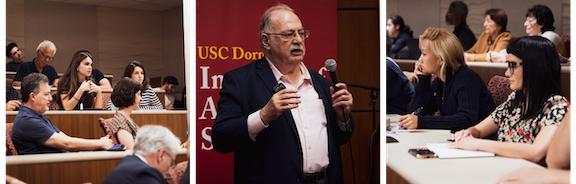
“The impact of a residency lies in the encounters it makes possible over time,” said Institute Director Dr. Shushan Karapetian. “Professor Tölölyan did not simply deliver a lecture and leave. He became part of the intellectual life of the university—engaging students, challenging scholars, and entering into meaningful conversation with a community whose lived experience has contributed so profoundly to the study of diaspora.”
The residency opened with “Diasporic Futures: Thinking Nationally, Living Transnationally,” a public lecture examining the tension between national frameworks and the transnational realities through which diasporic communities increasingly live. Tölölyan’s second lecture, “Ազգ, Անդրազգ, Սփիւռքազգ,” offered an Armenian-language exploration of the links between diaspora and homeland, and the complexities that define Armenian life across borders.
Together, the lectures demonstrated a defining feature of Tölölyan’s intellectual life: his embrace of comparative scholarship and ability to situate the Armenian experience within larger fields of inquiry, drawing from the particularities of one people’s history to illuminate questions with far-reaching global significance.
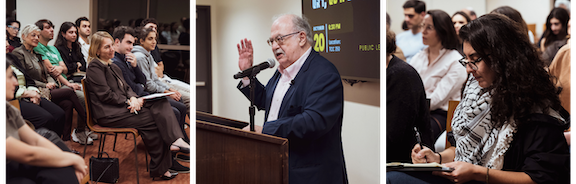
The program continued with “Living Diaspora, Thinking Diaspora,” a public conversation between Tölölyan and Drs. Talar Chahinian and Sossie Kasbarian, two of the three current co-editors of “Diaspora: A Journal of Transnational Studies.” Founded by Tölölyan in 1991, the journal provided an intellectual home for a field that was itself still taking shape.
The conversation traced the relationship between Tölölyan’s own diasporic journey and the ideas he helped bring into academic discourse, exploring how personal experience can become the foundation for an entirely new area of scholarship. With the journal’s founding editor in dialogue with two of its current co-editors, the event also offered a rare opportunity to reflect on the intellectual evolution of diaspora studies, the questions that continue to animate it, and the new challenges confronting the field.
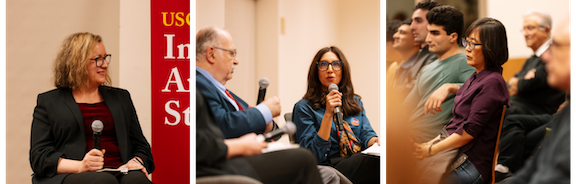
The residency also featured an intimate workshop for USC undergraduates who engaged Tölölyan in a conversation that moved between theory and lived experience. His own journey from molecular biology to comparative literature and ultimately diaspora studies offered a compelling reminder that intellectual trajectories are rarely linear. The workshop encouraged students from diverse backgrounds to question established categories, reflect on their own experiences, and consider how the questions we pursue are shaped by the lives we lead.
“Words are not enough to express how meaningful Dr. Tölölyan’s residency was for undergraduate students like me,” said Institute student worker Nare Babakhanian. “Put simply, in every event, workshop, and regular conversation with him, I not only learned something about myself, my family, and my diaspora, but I also had the opportunity to articulate my own impressions, insights, and lived experiences revolving around the Armenian diaspora, which fulfilled my intellectual curiosity as well as my soul.”
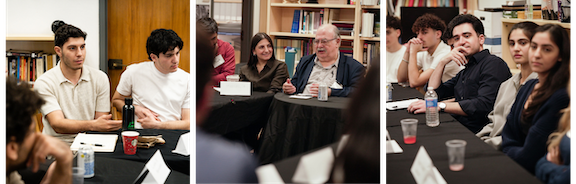
Tölölyan also joined Chahinian and Kasbarian for a workshop with scholars from across Southern California. Bringing together researchers working on different dimensions of Armenian diasporic experience, the gathering created space to revisit established frameworks, test emerging ideas, and partake in what Tölölyan called the “discussions and productive disputes” through which scholarship advances.
The residency also brought Tölölyan into the recording studio for an extended conversation on the Institute’s flagship podcast, Language Therapy with Dr. K. The forthcoming episode will unpack the foundational vocabulary we use to understand and articulate diaspora.
Across the residency, attendance from both the university and community underscored Los Angeles’s importance as a setting for these conversations. As a global center of diasporic life and home to the world’s most significant Armenian community outside Armenia, the city offered an environment in which the subjects of Tölölyan’s scholarship could be encountered not only as theory, but as reality.
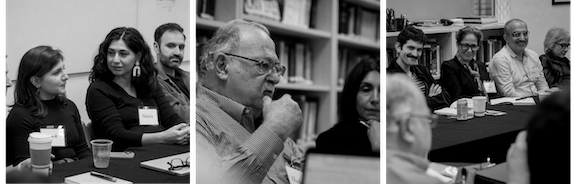
“There could be no more compelling setting for a residency devoted to diaspora than Los Angeles—a global crossroads of transnational communities, now emerging as the ‘capital’ of the Armenian diaspora,” Tölölyan said. “To think about diaspora here, in conversation with those who study it and those who live it, was both an intellectual privilege and a deeply meaningful experience. I leave grateful for the productive disagreements, unexpected insights, and new relationships that emerged.”
Launched in 2025 with internationally recognized historical-comparative linguist Dr. Hrach Martirosyan, the “Seminal Scholars Residency” brings transformative figures in Armenian Studies to USC for extended engagement with students, scholars, and the public. The program is designed to transmit the knowledge of scholars whose work has not simply contributed to their fields, but changed the terms through which their subjects are understood.
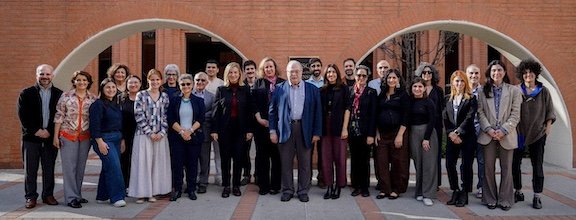
With Tölölyan’s residency, the Institute continued to position Armenian Studies as a source of ideas with global reach. More importantly, it demonstrated the distinctive value of sustained intellectual exchange: the opportunity not only to hear a seminal scholar, but to question, challenge, learn from, and think alongside one.