


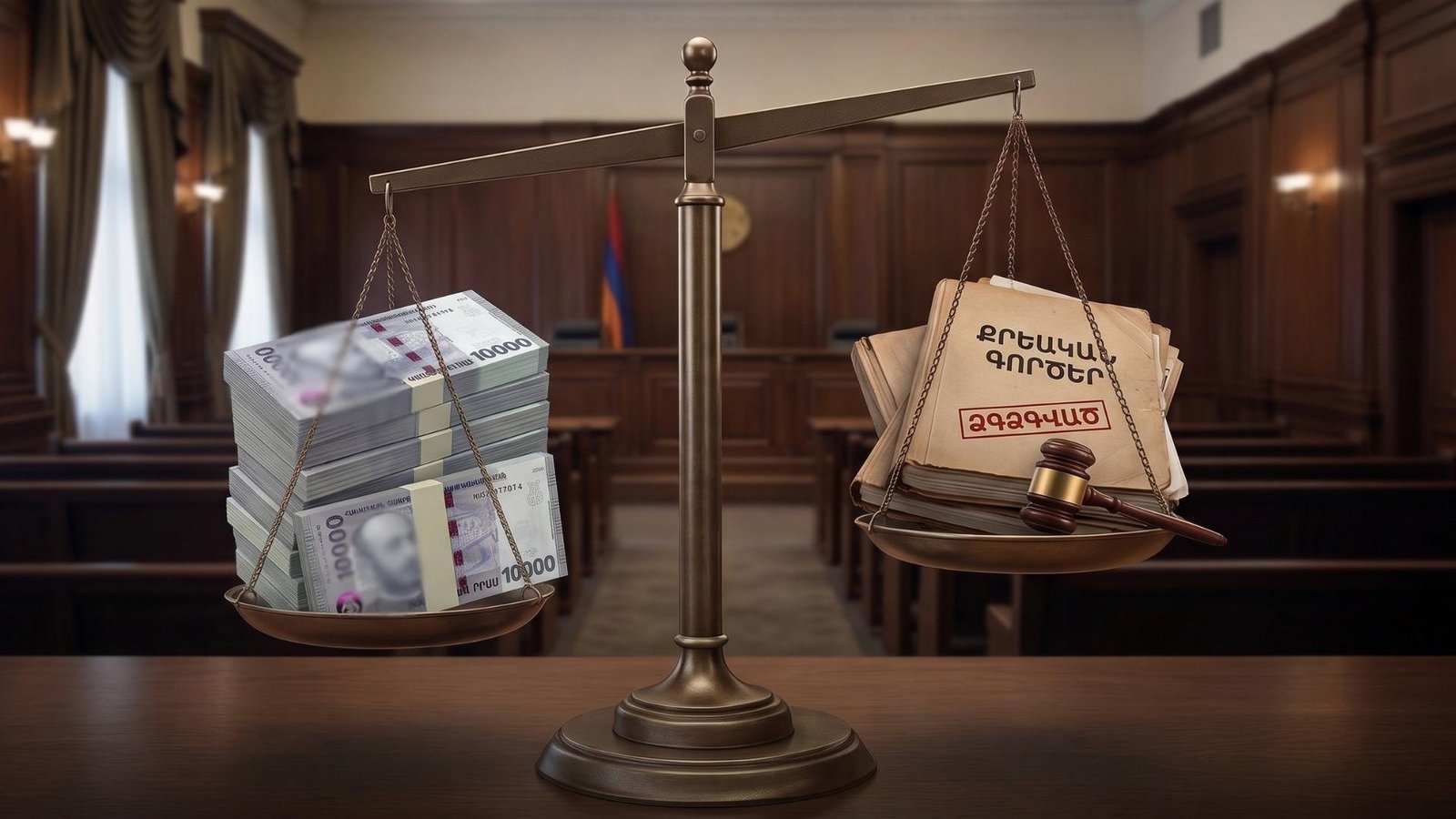
Criminal proceedings that have stalled for years continue to impose a significant burden on Armenia’s state budget.
Between 2020 and August 18, 2026, roughly AMD 167 million (US$458,388) was paid to six judges whose powers had been suspended while they faced criminal proceedings. These judges receive monthly compensation for forced downtime not caused by employee fault even though the cases against them have remained stagnant for years.
As of August 18, 2026, the powers of three bankruptcy judges have been suspended: Ara Kubanyan, Gevorg Narinyan, Tigran Poladyan; Judge Artush Gabrielyan (Yerevan Criminal Court of First Instance); and Judge Naira Grigoryan (Armavir Province Court of First Instance).
Since October 2022, the powers of Judge Arusyak Aleksanyan (Yerevan City Court of General Jurisdiction) were also suspended, but he submitted a resignation letter, and the Supreme Judicial Council terminated his powers on August 14, 2026.
The suspension of the powers of judges is due to criminal proceedings initiated against them. Despite the charges brought, they are considered innocent until the final act of the court.
One of the legal guarantees arising from the presumption of innocence is compensation for downtime. According to Armenia’s Judicial Code, during the suspension of powers, judges are paid as employees who are inactive through no fault of their own. According to the country’s Labor Code, this compensation is two-thirds of their average hourly wage.
However, criminal investigations often last for years. As a result, judges may remain unable to perform their duties while continuing to receive compensation under the presumption of innocence.
This safeguard is essential to judicial independence, ensuring judges are not punished before a final verdict. However, it raises a legitimate question: how reasonable is it to use public funds for years to pay individuals who are not performing judicial functions?
Bankruptcy Court judges Ara Kubanyan and Gevorg Narinyan have had their powers suspended since July 21, 2020—the longest such suspension. They have remained in this status for more than six years, while the criminal cases against them are still unresolved.
The criminal case against Narinyan and Kubanyan was sent to court in April 2022. Four years later, it is still being examined by the first-instance court. If either party appeals the verdict, the case could spend at least another year in higher courts, but it remains unclear when the first-instance proceedings will conclude.
The powers of another Bankruptcy Court judge, Tigran Poladyan, have also been suspended since December 2023. His criminal case has been under review in the Anti-Corruption Court since January 2024, but no verdict has been issued.
Over the past six years, this uncertainty has cost the state budget about AMD 167 million. Although the payments were made under legal guarantees for judges, the expense continues as long as the criminal cases remain unresolved, with the annual total rising each year. As a result, a safeguard meant to protect judges’ legal rights has, amid prolonged litigation, become an ongoing financial obligation for the state.
If you found a typo you can notify us by selecting the text area and pressing CTRL+Enter