


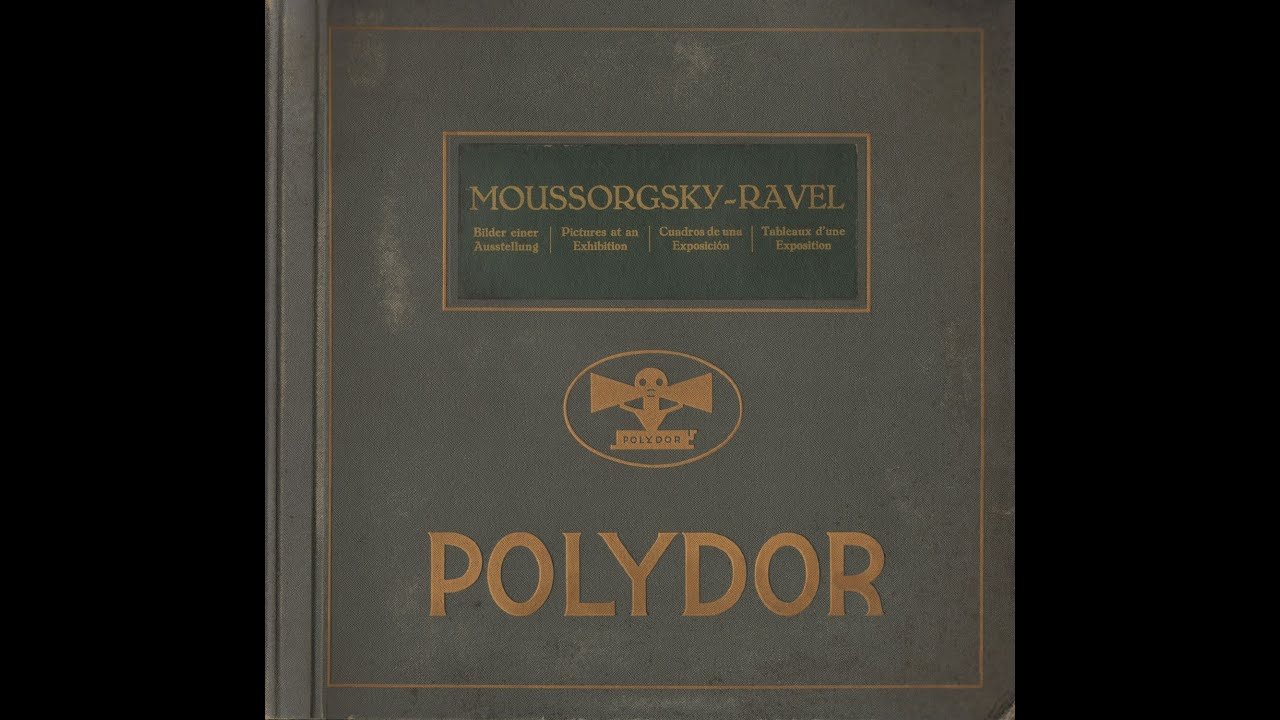
Orch. Staatsoper Berlin c.b. Alois Melichar:
00:00 Modest Moussorgsky, orch. Maurice Ravel: Pictures at an exhibition
Promenade
Gnomus
Promenade
04:55 The old castle
Promenade
Tuileries
Bydlo
Promenade
14:37 Ballet of the chicks in their shells
16:17 Samuel Goldenberg and Schmuyle
Limoges, the market place
19:27 Catacombs: roman sepulchre; Con mortuis in lingua mortua
23:55 The hut on fowl’s legs
27:27 The great Gate of Kiev
78rpm 30 cm: Polydor 27246-9 (B 61647-53)
Matrix nrs.: 1139½; 1140; 1141; 1142½; 1143½; 1144½; 1145 BI 1
31:52 Michael Glinka: Kamarinskaya: fantasy on 2 Russian folk songs
78rpm 30 cm: Polydor 27249 (B 61654)
Matrix nr.: 1184½ BI 1
Both recorded 1931
Alois Melichar (Vienna, 18.04.1896 – Munich, 09.04.1976): Austrian conductor, composer and music critic. Studied in Vienna and Berlin, among others with Franz Schreker (1920-1923).
1923-1926: conductor, choirmaster and teacher in Azerbaijan, Armenia, Turkestan and Georgia
1926-1927: music editor of the Deutsche Allgemeine Zeitung.
1927-1933: first conductor and musical director of Deutsche Grammophon.
After 1933, he worked mainly as a film composer, thanks to the mediation of the conductor Erich Kleiber. He composed, among other things, the music for the film Der Walzerkrieg, and for four films with the tenor Beniamino Gigli. He also had a part in propaganda films of the Nazis.
After 1945, Melichar tried to hide his role in the Nazi period.
1945-1949: conductor with the Wiener Philharmoniker and Wiener Symphoniker
1946-1949: worked as the head of classical music at the Austrian radio station Rot-Weiss-Rot
After 1949, Melichar worked again mainly as a film composer. In total, he wrote music for 61 films.
As a composer, he composed in the neoclassical style (Reger, Pfitzner). He was fiercely polemic against the music of Schönberg and his followers.
Besides music for films, he wrote a symphonic poem: Der Dom (1934).
In this post, Moussorgsky’s Pictures at an exhibition (1874) in Ravel’s orchestration. A performance with different tempi than we are used to, sometimes much faster, sometimes much slower – of course, in that period (1931) there were not many reference possibilities.
Ravel wrote his orchestration in 1922, commissioned by the conductor Sergei Koussevitzky, who gave the phonographic premiere in 1930 with the Boston Symphony Orchestra.
There have been dozens of people who have orchestrated the piano part of this composition, including Sir Henry J. Wood (1915), who withdrew his version after hearing Ravel’s. The conductors Leopold Stokowski (1939) and Walter Goehr (1942) have also made orchestrations.
Link to my 78rpm and LP collection at archive.org:
source
1 Comment
Thank you. Very interesting performance. Sounds like there are added percussion here and there — for example, in the middle section of Baba Yaga?